In this guide
The solo trip, from garage floor to shoreline
A 12-foot kayak is easy to paddle and awkward to carry. The trouble starts the moment the hull leaves its rack: one end drags and the other swings into the car. Your shoulder then takes the whole load on a walk that can run a few hundred yards from the parking lot to the launch. Two people solve it by each taking a handle. One person needs wheels under the middle of the boat, a way to hold the boat still on the water, and a way to protect it between trips.
The RAD Sportz paddle gear covers those three jobs in order. The Kayak Cart carries up to 150 pounds on two 10-inch airless wheels and folds into its own mesh bag. Next comes the Folding Kayak Anchor, sold in 3.5 lb and 5.5 lb weights with 40 feet of rope, a buoy and a snap hook. Last, the Kayak Cover comes in two lengths and pulls tight with a drawstring and three buckle straps. At the launch area, a pair of Folding Kayak Stands holds the boat off the sand while you load it.
Think of the trip as four handoffs. In the garage, the boat comes off its hooks or hoist and lands on the cart. On the way, the cart carries the weight and you steer. At the water, the cart folds and rides inside the boat. On the water, the anchor holds your spot when you stop to fish, eat or rest. Then everything happens in reverse, and the cover goes on before the boat goes back up.
Each handoff has one detail that decides whether it works alone. With the cart, it is the balance point under the hull. For the anchor it is where the rope leaves the boat, and for the cover it is the boat's length against the size printed on the bag. Get those three right and the rest is just walking and paddling.
A boat that lives on the wall needs one more step before the cart. If the kayak hangs on hooks or straps, lower it onto the cart directly rather than onto the floor, so you lift it only once. Our guide on how to store a kayak in a garage explains where hooks and hoists go and at what height. That height matters here too, because a boat resting at hip height slides onto a cart far more easily than one you have to lift from the floor. RAD Sportz has been building storage and transport gear for paddlers since 2008, and every piece mentioned here works for kayaks, canoes and stand-up paddleboards within its stated limits.
Where the cart goes under the hull
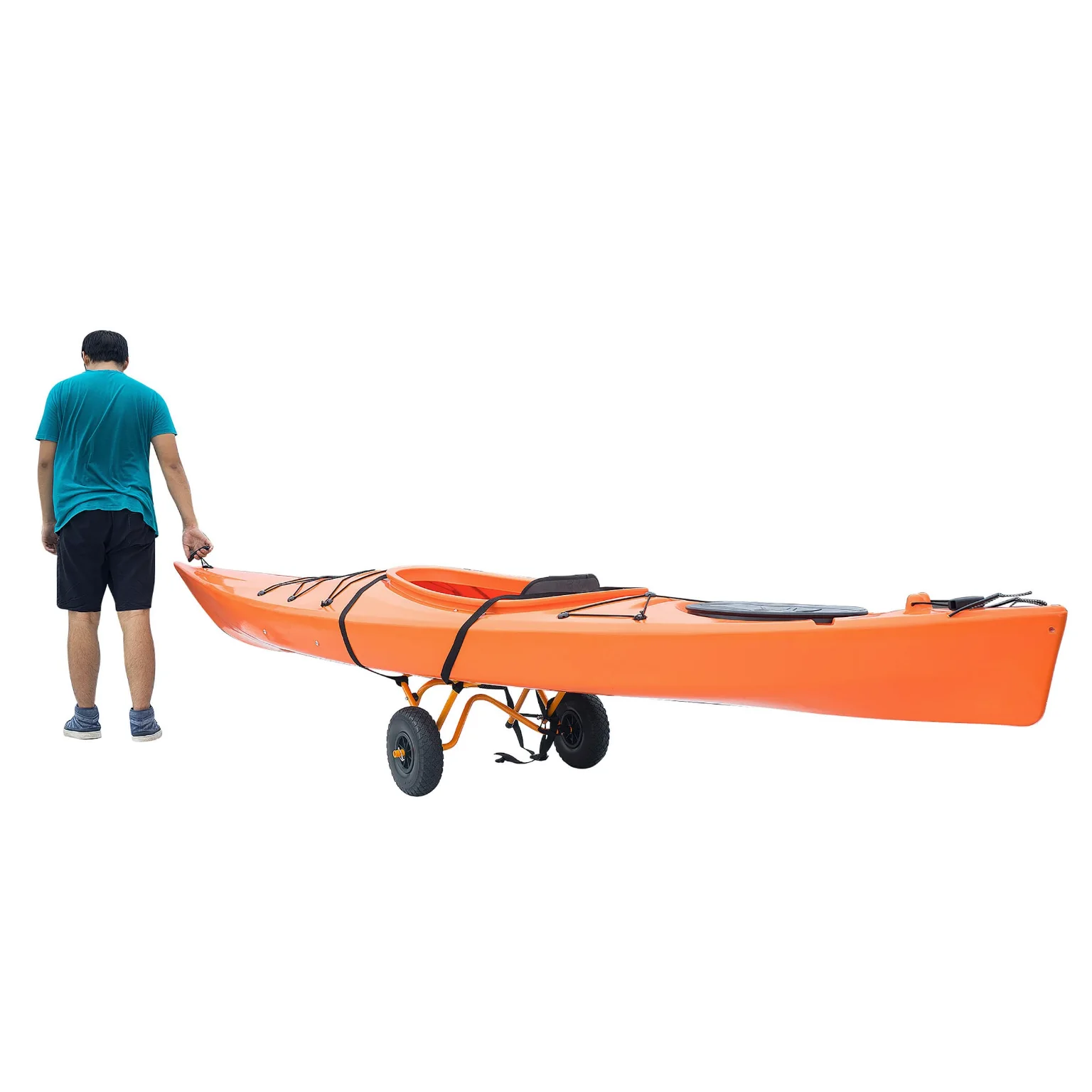
Balance decides how much of the boat you carry. A kayak cart is a lever: the wheels hold most of the weight, your hand at the bow handle holds the rest, and where the cart sits under the hull sets the split between them. Put the cart near the stern and the bow presses down into your hand. Put it near the center and the boat teeters, nosing into the ground on every bump. The sweet spot for most single kayaks is a little behind the middle, where the bow just lifts off the ground with light pressure and stays level when you walk.
Finding that spot takes about a minute. Set the cart on its double kickstand, which holds the frame upright while you work, then lower the stern of the kayak onto the rubber cradles. Slide the boat forward over the cradles until lifting the bow handle feels like holding a full grocery bag rather than a suitcase. On a sit-inside kayak, that point usually lands just behind the cockpit. A sit-on-top with a heavy rear tank well may need the cart a few inches farther back once a crate is loaded.
Load matters as much as position. The cart is rated for 150 pounds, and that number counts everything sitting on it: the hull, the seat, a cooler, a crate of tackle and any water sloshing in the bilge. A long fishing kayak with gear can approach that figure faster than a bare recreational boat, so pack the heavy items over the wheels rather than at the bow or stern. Weight placed directly above the axle adds almost nothing to what your hand carries.
Strapping turns a balanced boat into a stable one. The cart comes with tie-down straps that wrap over the hull and around the frame. Cinch them until the boat cannot rock side to side on the cradles, but stop before the strap dents a thin plastic deck. One strap across the widest part of the hull, just over the cradles, is the usual setup. A second pass helps on a narrow boat that wants to roll.
The rubber cushioning on the cradles keeps the hull from sliding and keeps the aluminum frame off your gelcoat or plastic. Look at it each season: grit trapped under the rubber scratches the hull like sandpaper on a long walk.
Then lift the kickstand legs, take the bow handle, and walk. Pull rather than push. Pulling lets the wheels climb curbs and roots, while pushing digs the cart into anything in front of it. If you need both hands for a gate or a car door, set the stern down on the kickstand again and the boat waits upright where you left it.
Sand, gravel and the boat ramp
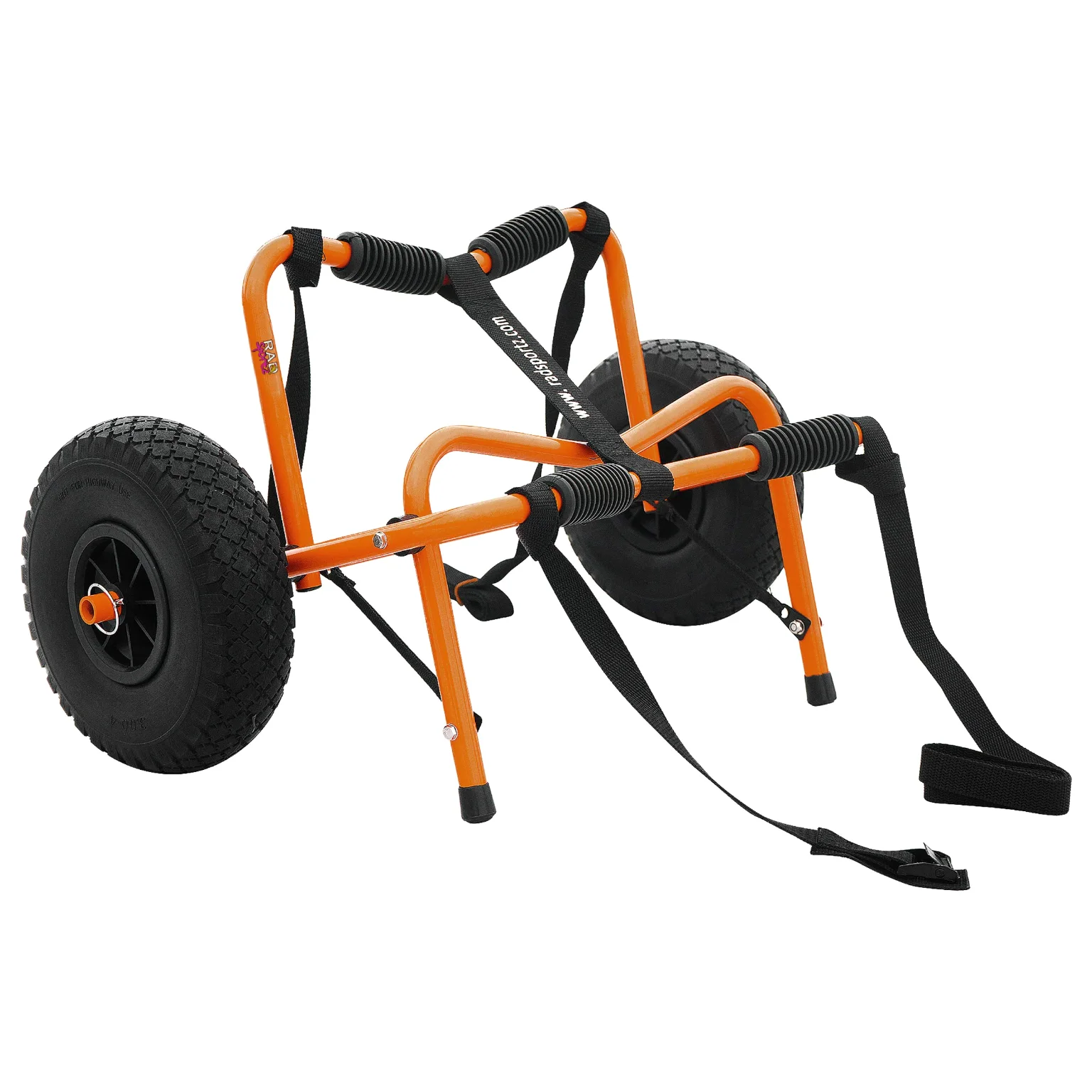
Wheels decide which ground is easy. The cart rolls on two 10-inch polyurethane wheels on polypropylene hubs. They are solid, so there is no tube to go flat, no pressure to set and nothing to patch at the water's edge. The tradeoff is that you cannot air them down for soft sand the way you would with inflatable tires. Large diameter helps instead: a 10-inch wheel rolls over a gap or a root that would stop a small caster.
Your path from the car to the water usually crosses more than one surface. Here is how each one behaves with a loaded boat.
| Surface | How the cart behaves | How you set up | Watch for |
|---|---|---|---|
| Pavement and parking lots | Rolls with almost no effort | Normal balance point, one strap | Curbs: pull the wheels up, never push into them |
| Packed dirt and wooded trails | Rolls well, roots cause bumps | Cart slightly farther back so the bow clears roots | Roots that catch one wheel and twist the boat |
| Gravel | Rolls, but wheels push stones ahead | Straps tight so the hull cannot shift | Loose patches where both wheels sink at once |
| Wet, packed sand | Firm enough to roll | Normal setup | Soft spots near the waterline |
| Dry, soft sand | Hardest surface for any narrow wheel | Heavy gear moved over the axle, short steady steps | Stopping: restarting in soft sand takes the most effort |
| Concrete boat ramp | Rolls easily downhill | Keep the boat behind you and walk slowly | Algae below the waterline, which is slick for feet and wheels |
Dry sand is where solo paddlers struggle most. A wheel sinks until the sand under it is firm enough to hold the load, and the more weight sits on the wheels, the deeper they go. Lighten the boat before the beach: carry the cooler as a separate trip, empty any water from the hull and keep the crate over the axle. Then walk at a steady pace. Momentum carries a cart across soft patches that it cannot start from.
Gravel launches reward tight straps. Stones shift under one wheel and not the other, which twists the frame and tries to roll the hull off the cradles. A boat strapped snugly moves as one piece with the cart.
Boat ramps reverse the usual problem. The cart wants to run away downhill, so stay on the downhill side of the bow handle and let the boat follow you. At the bottom, stop short of the water, drop the kickstand and float the boat off the cradles rather than wheeling the cart into the lake. Ramps are shared with trailers, so move the cart off the concrete as soon as the boat is floating.
Salt water and sand are the main wear on any cart. Rinse the wheels and frame with fresh water after a beach launch, and spin the wheels to clear grit from the hubs before folding the cart.
The cart rides in the boat, the stands wait on shore
A cart left on the beach is a cart you walk back for, and a solo paddler often lands somewhere other than where the trip began. Bringing the cart along solves that, and the design makes room for it. The frame is powder-coated aluminum and folds flat. Each wheel comes off with a release pin, and the whole set packs into a mesh bag measuring 13 by 3 by 27 inches. Assembled, the cart measures 28.5 by 7 by 13.5 inches, and the spec sheet lists its weight at 4.39 kilograms, a little under 10 pounds.
Where it rides depends on the boat. On a sit-on-top, the rear tank well takes the bag, held down by the deck bungees or a strap. In a sit-inside kayak, the bag fits behind the seat if the cockpit is long enough, or lies on the rear deck under the bungees. On a stand-up paddleboard, it goes under the front deck bungees, where it adds weight forward of your feet. Wherever it goes, secure it. A loose cart shifts when you lean, and gear that is not tied down floats away after a capsize.
The pins are the part to keep track of. Clip them back into their holes on the axle or keep them in a zippered pocket, never loose in the bottom of the boat. A spare pair costs little and saves a long walk.
Folding Kayak Stands handle the other end of the trip. The set of two stands 17 inches tall, holds up to 100 pounds of combined weight, and folds down to 6.25 inches wide into its own mesh bag. At the launch area, they hold the boat at a comfortable working height while you load the hatch, fit the seat or attach the anchor kit. Nylon straps and rubber bumpers keep the hull still on top. At home, the same pair works as a cleaning and repair station in the driveway, and a two-boat kayak stand does the same job permanently in a garage.
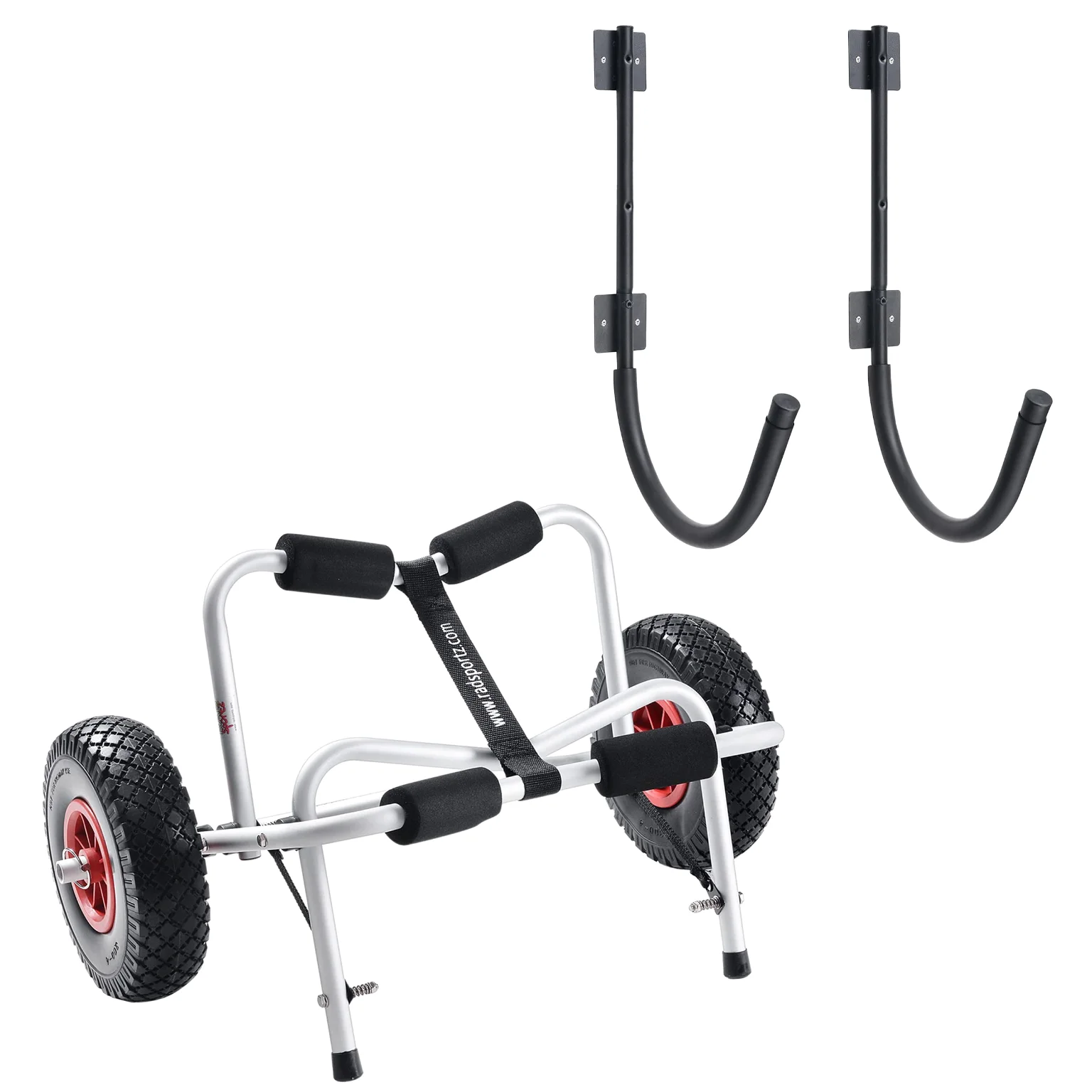
Some paddlers want the transport and the storage as one purchase. The Kayak Cart and Wall Hook Set pairs the same cart, with its 150-pound rating and two 10-inch airless wheels, with powder-coated steel wall hooks that mount into the wall studs and hold up to 100 pounds. You choose padded J-hooks or strapped hooks. The hooks measure 15.25 by 3 by 25 inches, and the boat goes from the wall straight onto the cart parked underneath it.
Everything else on the paddle gear shelf follows the same idea: one person, one trip, nothing left behind on the beach.
Choosing the anchor weight
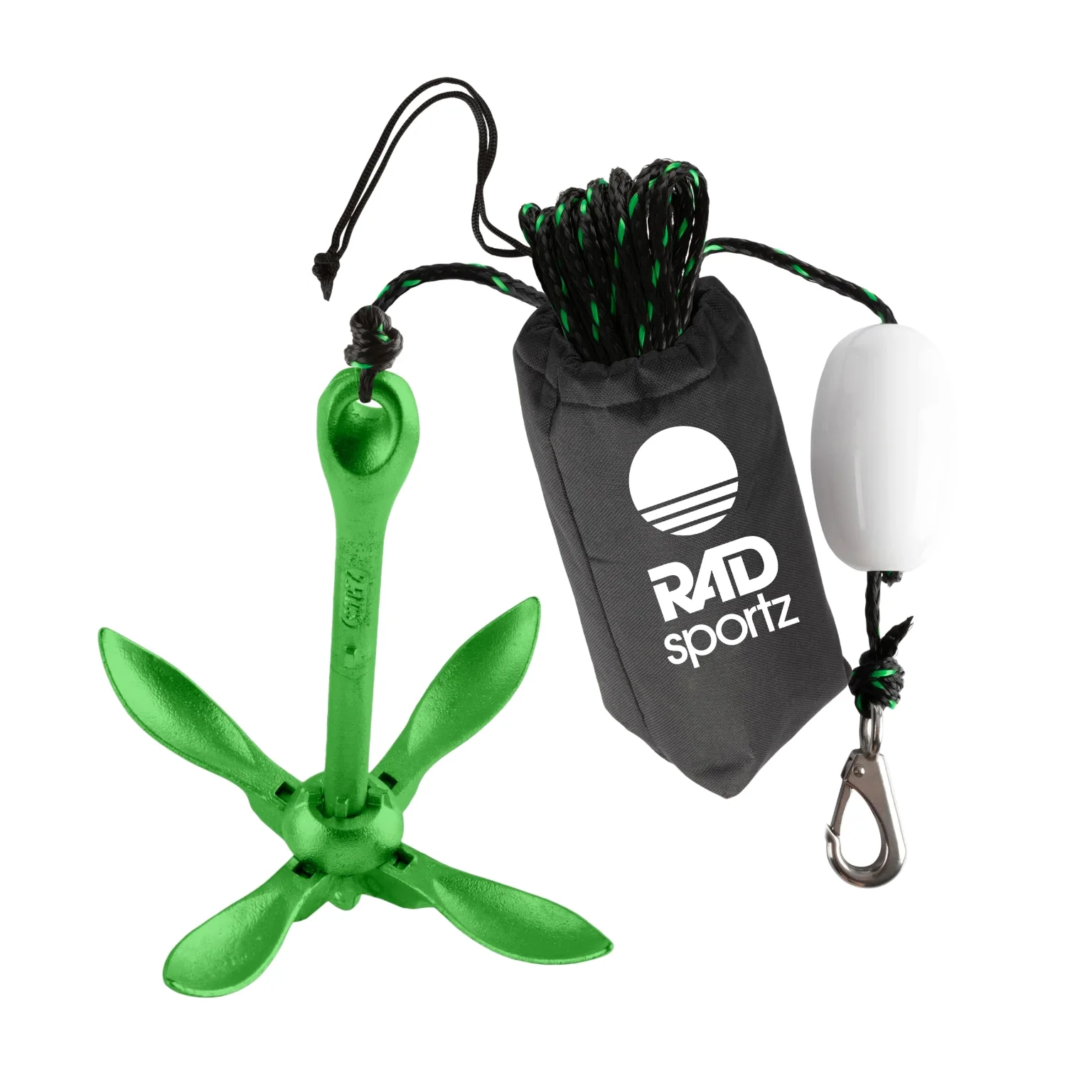
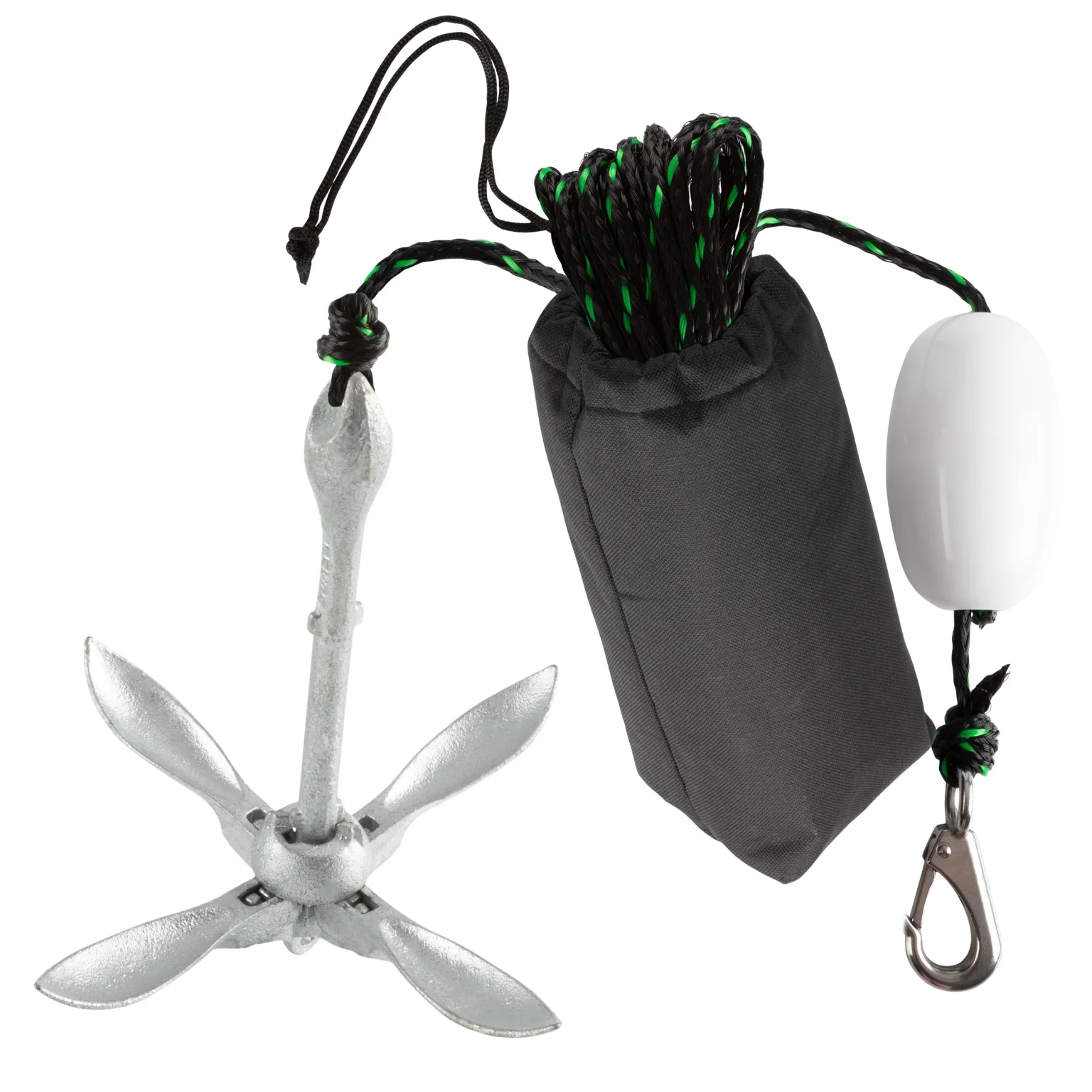
An anchor for a kayak has a different job from an anchor for a powerboat. It holds a light boat in light water: a cove while you fish, a sandbar while you eat, a spot out of the boat lane while you rest. The Folding Kayak Anchor is a grapnel, a central shank with four arms that open and hook into the bottom. The arms fold flat against the shank for storage, collapsing to 3 by 3 by 12.5 inches. Opened, the anchor spreads to 11 by 11 by 12.5 inches.
The kit comes ready to use. The anchor is galvanized steel for fresh and salt water. It ships with 40 feet of 7 mm marine rope, a PVC buoy, a stainless steel snap hook and a padded carry bag that keeps the arms from scratching your deck. The two weights are 3.5 lb and 5.5 lb, in silver or green.
The BoatUS Foundation describes grapnels plainly: they are inexpensive and have little holding power. That is not a flaw for a kayak. A grapnel grabs rocks, weed beds and debris that a fluke anchor slides over, and it usually comes free when you pull straight up. It is also a hint about limits. A grapnel is a fair-weather tool for still or slow water, not a way to hold a boat in a strong current.
Iowa's Department of Natural Resources suggests a kayak anchor of about 10 pounds or less, with folding claw arms for a better hold in current or wind. Both RAD Sportz weights sit well under that ceiling. The choice between them comes down to your boat and the water you paddle.
| Your boat and water | Anchor | Why |
|---|---|---|
| SUP or short recreational kayak on a pond or calm cove | 3.5 lb | Light boat, little wind, easy to lift aboard from a standing or seated position |
| Recreational kayak on a small lake with a light breeze | 3.5 lb or 5.5 lb | More weight gives the arms more grip when a breeze pushes the boat |
| Fishing kayak loaded with a crate and cooler | 5.5 lb | More weight and more windage need more grip |
| Canoe or tandem kayak | 5.5 lb | A longer, taller boat catches more wind |
| Any boat in strong current, waves or high wind | Neither | Paddle to sheltered water rather than anchoring |
Rope length sets the practical depth. The BoatUS Foundation recommends a scope of 7:1, seven feet of rope for every foot of water depth, and says 5:1 is enough for a lightweight anchor on a small boat in good weather. With 40 feet of rope, that means water up to about 8 feet deep at 5:1, or under 6 feet at 7:1. Deeper water needs more line than the kit carries.
Folding anchor
RAD Sportz Folding Kayak Anchor
A folding grapnel kit with rope, buoy, snap hook and bag.
From $27.50Price range: $27.50 through $39.95 
Anchoring a kayak without turning it sideways
Where the rope leaves the boat matters more than the anchor's weight. A kayak tied off at the cockpit, beside your hip, swings until it sits broadside to the wind or current. In that position the whole length of the hull catches the push, the boat leans toward the rope, and a wave from the side lands on your lap. Anchor the same boat from one end and it swings to point into the flow, presenting only its narrow bow.
The BoatUS Foundation gives the rule for small boats directly: head into the wind or current, lower the anchor rather than throwing it, and secure the line at the bow. It also warns never to anchor a small boat by the stern, because the bulk of the weight rests there and stern anchoring is likely to result in swamping and flooding. That warning is written for boats with an engine at the back, but the principle carries over to a kayak. The anchored end takes the pull of the rope, so keep heavy gear away from it and let it ride high.
An anchor trolley is the usual way kayak anglers move the anchor point to an end without crawling along the deck. It is a loop of line running through two pad eyes, one near the bow and one near the stern, with a ring that slides along it. Clip the anchor rope to the ring with the snap hook, pull the ring to the bow or the stern, and the boat turns to face the wind from that end. Without a trolley, clip the rope to the bow handle before you launch and run it back to where you can reach it.
The BoatUS Foundation also notes that an anchored boat can swing a full 360 degrees as the wind shifts or the current changes. Leave room around you, and stay clear of docks, moored boats and fallen trees.
Current is the reason to keep anchoring simple. Moving water has, in BoatUS's words, literally tons of pressure behind it. The National Park Service warns on its Ozark river page that current can pull you underwater in less than a second. A kayak held by its anchor in moving water becomes an obstacle the river pushes against, and if it tips, the rope still holds it in the flow.
So keep a release you can work with one hand. The snap hook on the kit is that release: unclip it from the trolley ring or the bow handle and the rope and buoy float free, marking the anchor so you can come back for it. Practice unclipping it on calm water before you need it. Never wrap the rope around your hand or cleat it where you cannot reach it.
Retrieval is the reverse. Paddle up to the buoy, pull straight up, and the folding arms let go of the bottom. Fold them back, bag the anchor, and coil the rope so it is ready next time.
Life jackets on a solo trip
Wheels and an anchor make a solo trip possible on land and on the water. They do not change what happens if you end up swimming. The rules and advice from public boating bodies are short and consistent.
The US Coast Guard states that a recreational vessel must have a Coast Guard Approved wearable life jacket for each person on board. Federal law also requires children under 13 to wear one while the vessel is underway. State rules can go further. Iowa, for example, requires life jackets on every watercraft, including kayaks, canoes and paddleboards. Check your own state's rules before the season starts, because the requirement for adults to wear rather than carry a jacket varies.
Carrying is the weak point. The Coast Guard notes that a life jacket can save your life, but only when you wear it. The National Park Service puts the reason plainly: in the event of flipping a canoe, kayak or tube, there is no time to put on a PFD. A jacket stuffed behind the seat or bungeed to the deck does nothing for a paddler already in the water. The BoatUS Foundation calls the PFD your single best piece of safety equipment and says to wear it whenever you are afloat.
Fit matters for a paddler. A jacket cut for paddling leaves the shoulders free for the stroke and has a short torso so it does not ride up against the seat back. Try it seated in the boat, arms moving, before you buy. Inflatable jackets are comfortable, but the Coast Guard says they are not appropriate for weak or non-swimmers, and an inflatable must have a full cylinder and green status indicators to count at all.
There is one more point a solo paddler should hear. The BoatUS Foundation advises paddlers to travel with a group and never alone, and to assume no one else will be there to help. A cart lets you move the boat by yourself. It does not replace a partner on the water. When you do go out alone, tell someone where you will launch and when you expect to be back, stay close to shore, and keep to water within your skill level.
Clip the jacket on at the car, before you start rolling the boat toward the ramp. Then it is already on when your feet first touch the water.
Covering the boat between trips
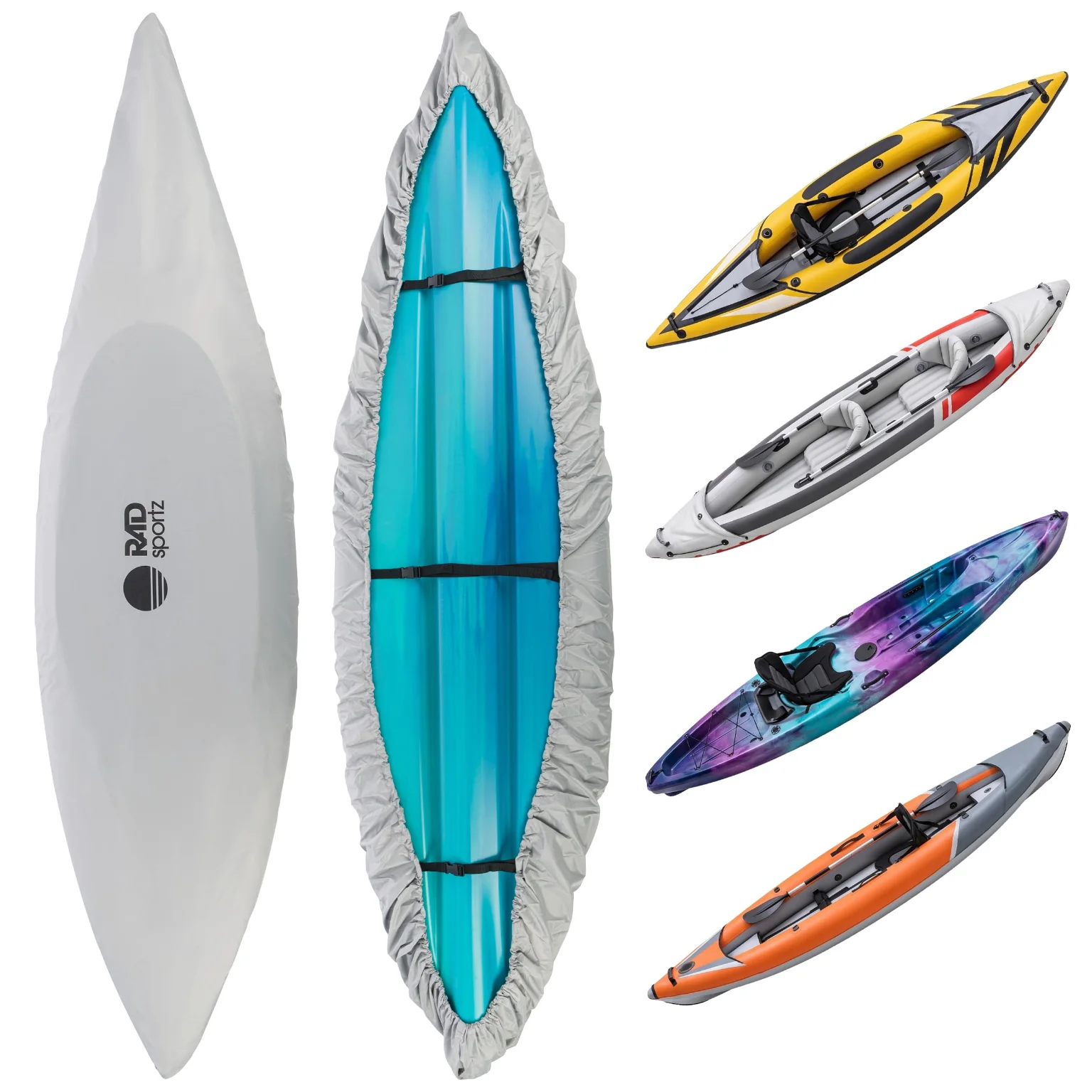
Sun is harder on a kayak than water. Months of direct light fade a plastic hull, and a boat stored outdoors collects leaves, rain and spiders in its cockpit. A cover keeps all of that off and lets you store the boat outside on stands or a rack when the garage is full.
The RAD Sportz Kayak Cover is built in three layers: 420D Oxford fabric, a PU coating that sheds rain, and an anti-UV lining against the sun. An elastic drawstring runs around the perimeter so the edge hugs the hull. Three adjustable buckle straps pass under the boat and pull the cover down so wind cannot lift it. The smaller size measures 155 by 55.5 inches flat and weighs 1.62 pounds, so it packs into a hatch or the cart bag on a camping trip.
Size by boat length, measured tip to tip. The two sizes are 10.8 to 12 feet and 12.3 to 13.5 feet. That leaves a gap between 12 feet and 12.3 feet, so a boat of 12 feet 2 inches falls in neither range. In that case, go up a size: a slightly long cover can be gathered by the drawstring, while a short one leaves the bow or stern bare.
| Boat length | Cover size | Fit |
|---|---|---|
| Under 10.8 ft | 10.8 to 12 ft | Loose at the ends, gather with the drawstring and straps |
| 10.8 to 12 ft | 10.8 to 12 ft | Sized for this range |
| Over 12 ft, under 12.3 ft | 12.3 to 13.5 ft | Go up a size so the ends are covered |
| 12.3 to 13.5 ft | 12.3 to 13.5 ft | Sized for this range |
| Over 13.5 ft | Neither | Too long for either size |
Width matters too, especially for fishing kayaks and SUPs. A wide sit-on-top with a raised seat and rod holders needs more fabric over the top than a sleek touring kayak of the same length. If your boat is long for its range and also wide, the larger size gives the straps room to reach under the hull.
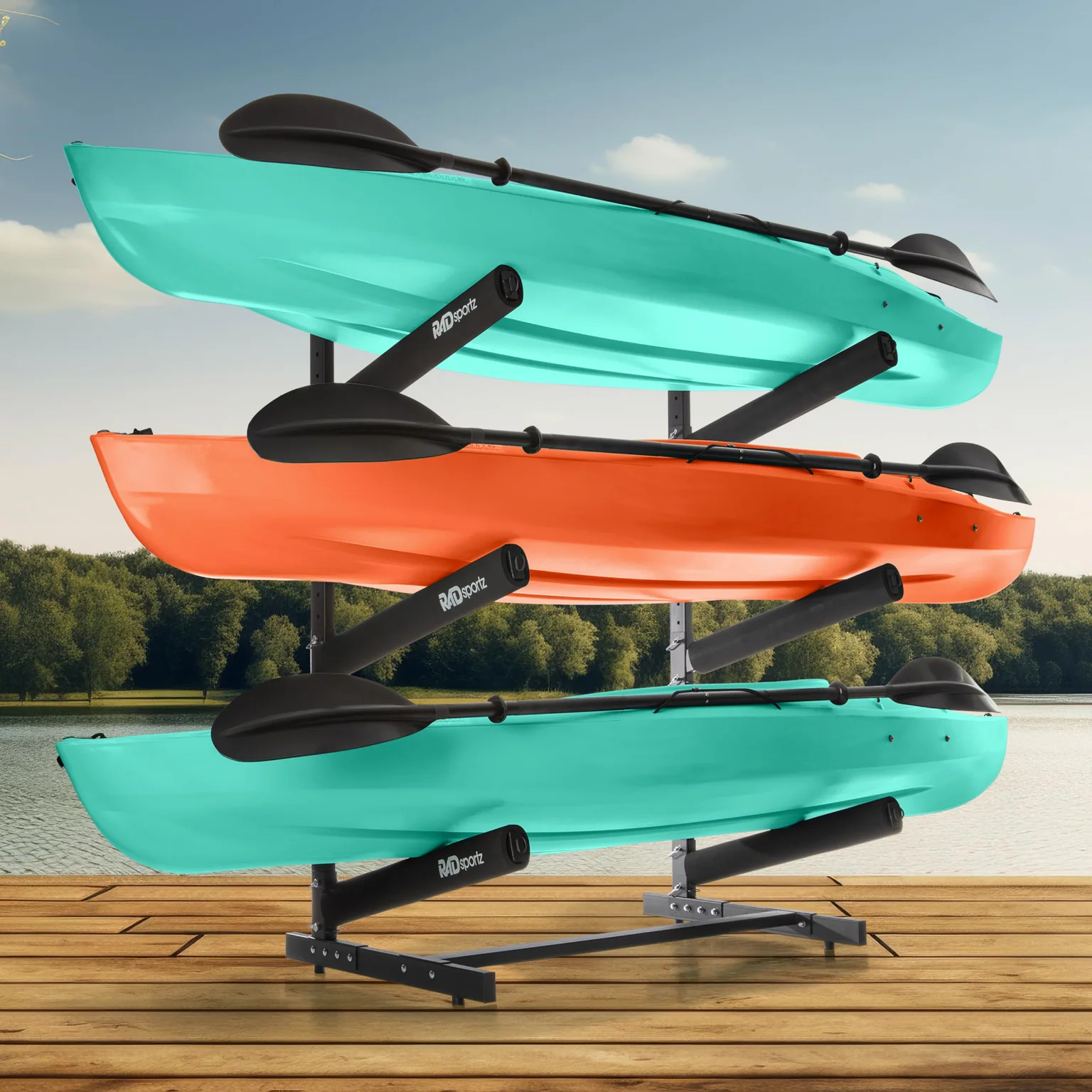
Cover only a dry boat. Water left in the cockpit or hull under a coated fabric has nowhere to go, and a damp hull under a cover grows mildew over a wet week. Sponge out the cockpit, open the hatches for an hour, then cover. Outdoors, store the boat hull up or on its side on stands so rain runs off the cover rather than pooling in a dip. Indoors, the same cover keeps dust and garage grime off a boat hanging from a hoist or resting on wall hooks, and the kayak storage shelf has the hooks, straps and stands to hold it there.
Everything named in this guide is part of RAD Sportz storage gear, and our Paddle Gear shelf has every option with its price.