In this guide
How a kayak hull wants to be held
On the water, a kayak floats on pressure that pushes evenly against the whole hull. In a garage that support disappears, and the boat rests on whatever touches it: two hooks, two straps, two padded arms. Every storage method raises the same two questions. Where does the weight go, and how wide is the patch that carries it?
Two support points, each set roughly a third of the way in from an end, are the usual answer. Spaced like that, they split the boat's weight evenly and keep the bow and stern overhangs short enough not to droop. A single point in the middle, or a hook through one grab handle, puts the whole weight of a plastic boat on a few square inches. Over a season that spot can flatten or dent, and a polyethylene hull tends to keep the new shape. Grab handles are made for carrying a boat for a minute, not for hanging it for months.
Width matters as much as position. A padded arm or a wide nylon strap spreads the load across the curve of the hull, while a thin rope or a bare steel bar concentrates it on a line. For that reason every rack in the RAD Sportz range carries foam, rubber or a strap wherever it touches the boat.
Cockpit up, down or on edge
Three orientations work, and they suit different racks. On edge, with the boat lying on its side, is the strongest position: the side of a kayak is curved and stiff, so it resists denting better than the flatter bottom. Wall hooks and freestanding racks hold boats this way. Deck down, with the cockpit facing the floor, suits ceiling storage and outdoor racks, because rain and dust cannot collect in the cockpit. Cockpit up is fine for a few weeks on padded stands, but over a long winter it is the position most likely to leave flat spots, since the bottom carries the weight directly.
Straps and heat
A storage strap holds a boat in place. It should not squeeze it. Cinched as hard as it would be on a car roof, a strap presses on the same line for months, and a plastic hull can take a groove from it. Snug is enough: the boat should not slide, and the strap should not dig in.
Heat makes every one of these problems worse. Plastic softens as it warms, so a boat stored against a sunny window, under a dark roof deck or beside a water heater deforms faster under the same load. The cool, shaded side of the garage will treat your hull better than the warm one.
Ceiling storage with a hoist or straps
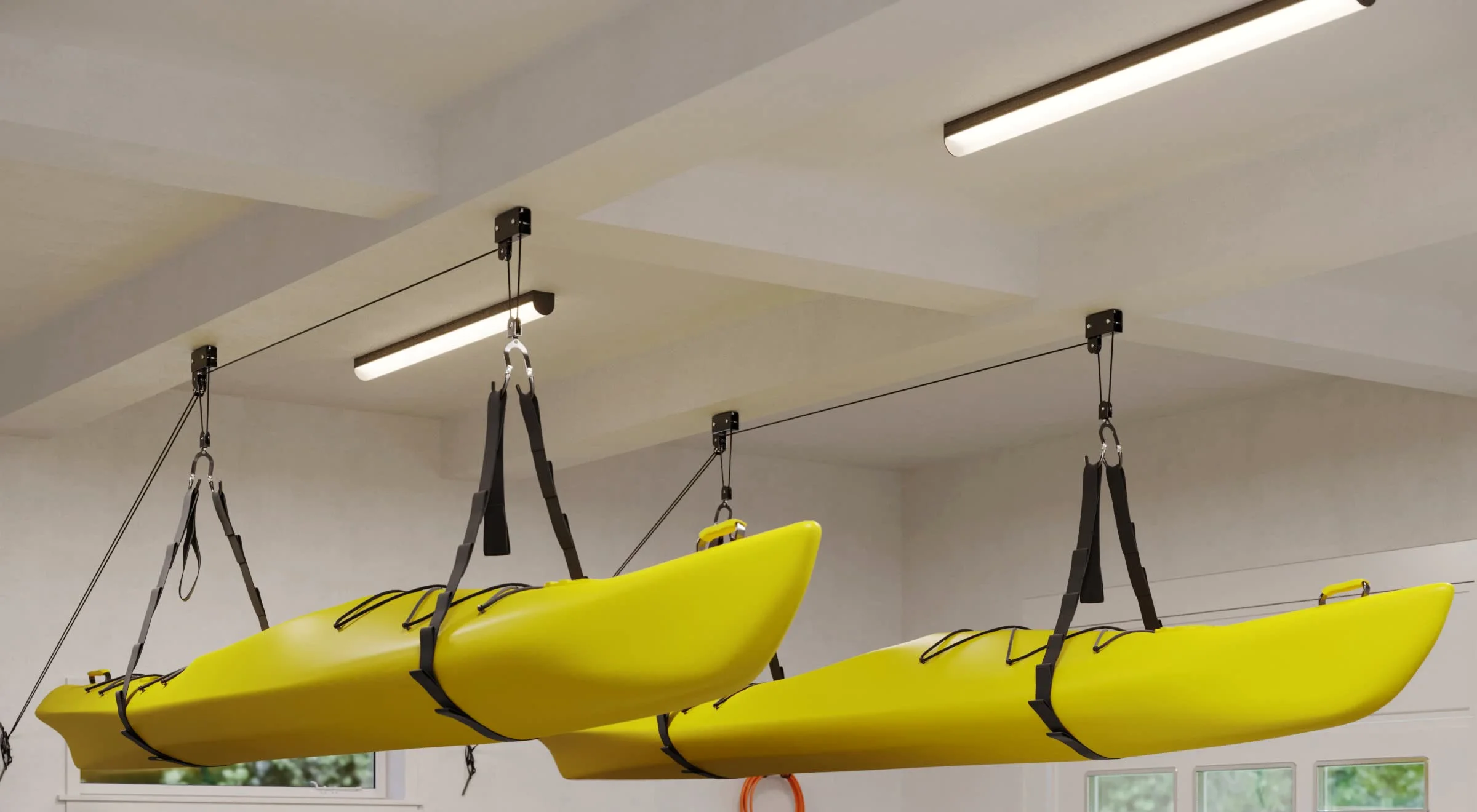
Most garages leave the ceiling empty, which makes it a natural home for a kayak once the floor and walls belong to the car, the bikes and the shelving. Two methods get a boat up there. A pulley hoist lifts it, while fixed straps hold it at a height you can reach.
The RAD Sportz Kayak Hoist
The RAD Sportz Kayak Hoist is rated for 125 lb and comes with enough rope for ceilings up to 12 ft tall. Its hooks are rubber-coated so they do not scratch the hull, and the pulleys should be placed so the hooks meet the boat about a third of the way in from each end. It can be mounted either parallel or perpendicular to the ceiling joists, which helps when the boat has to hang across the framing rather than along it.
One person can raise a loaded hoist because of the rope brake. It pinches the rope with every pull, so when you stop pulling, the boat stays where it is instead of running back down. Once the kayak is up, the free end of the rope ties off to the included cleat on the wall or ceiling, and the cleat holds the load from then on. Lowering is the same motion in reverse: release the brake, let the rope pay out slowly through your hands, and set the hull down on a cart or a pair of stands. A Kayak Cart parked under the hoist means the boat goes straight from the ceiling to the wheels.
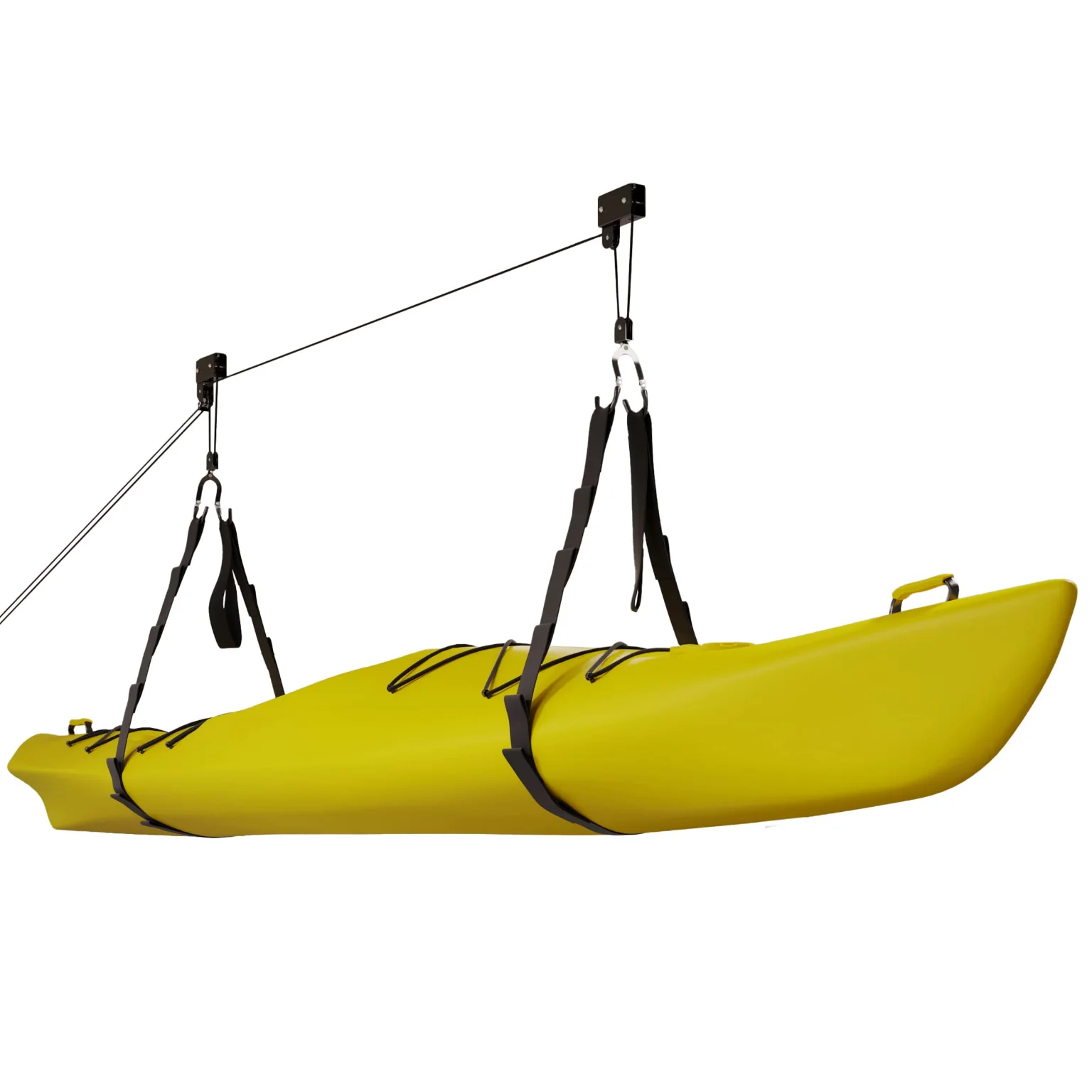
Ceiling hoist
Pulley lift with a rope brake for ceilings up to 12 ft.
From $20.34Price range: $20.34 through $39.80 
If a bike or a ladder also needs a spot overhead, the Kayak and Bike Hoist Set pairs the 125 lb kayak hoist with a smaller hoist for the second load.
Kayak Storage Straps on the ceiling
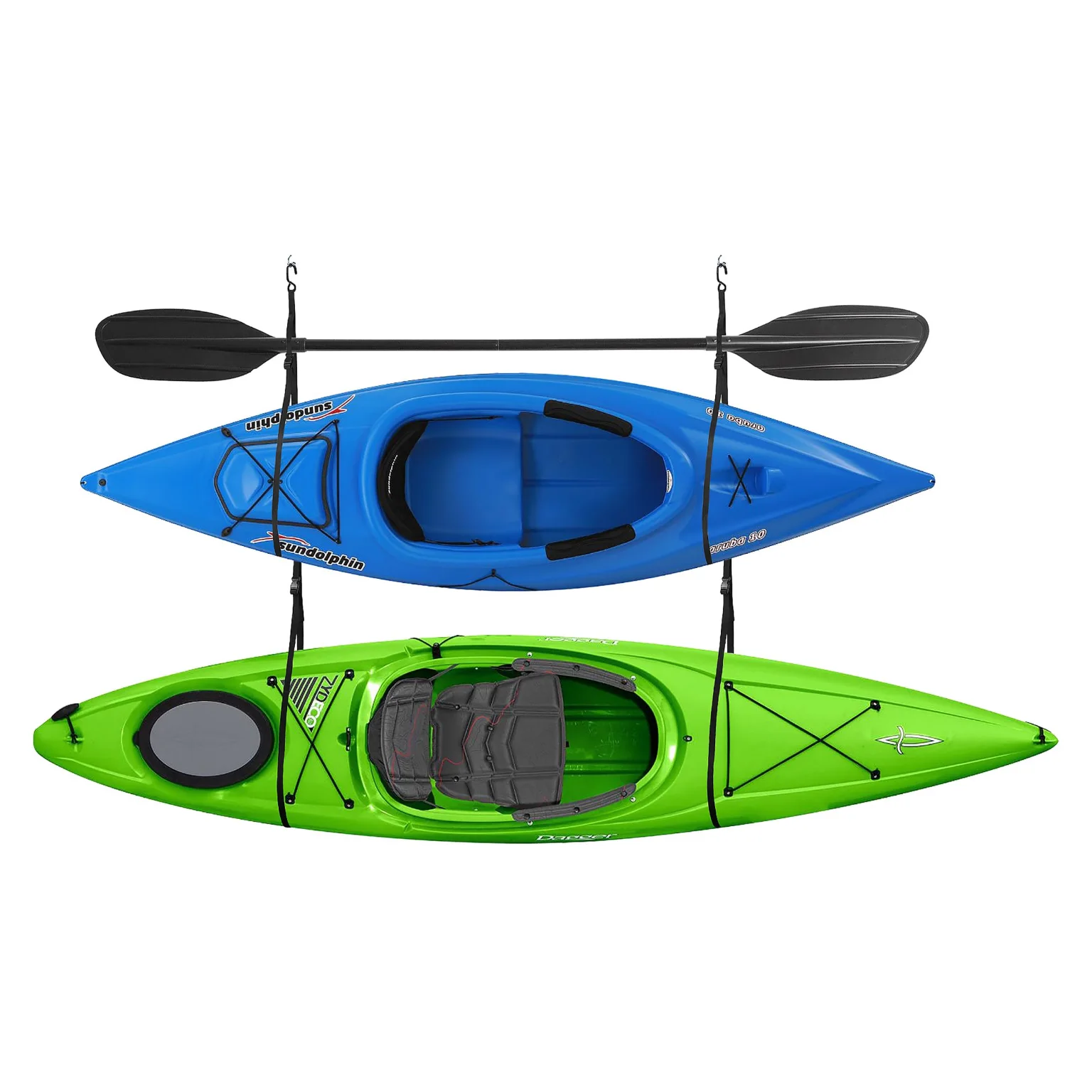
Nothing gets lifted by the Kayak Storage Straps. Two stainless-steel eyebolts screw into ceiling joists or wall studs, and nylon slings with quick-release buckles hang from them. The double version holds two boats up to 100 lb combined, and the single version is rated for 55 lb. Paddles can ride in the same slings.
Because you lift the boat into the slings by hand, straps make most sense on a ceiling low enough to reach from a step stool, or on a wall. The trade-off is simple. A hoist takes longer to install and then spares your back every time you paddle. Straps go up in a few minutes and ask you to raise the full weight of the boat over your head on each trip.
Joists, studs and the space under the boat
Anything that holds a boat to a building is only as strong as the wood behind it. Drywall alone will not carry a kayak, and a screw that misses the framing will pull out of the board. Ceiling products go into joists, the horizontal framing members above the ceiling. Wall products go into studs, the vertical members inside the wall. Find both before you mark a single hole.
A stud finder does most of the work. Confirm each hit with a small test hole or a finish nail before a lag screw goes in. Joists usually run in one direction across the whole garage, so once you locate two, the rest tend to follow the same spacing. When the hoist brackets do not line up with the joists you have, the hoist can be mounted on a length of 2x4 that is screwed across the joists, the same method used for overhead bike lifts. Our guide on how to install a bike hoist covers that bridging board.
No product can know how your garage was framed, so there is no load figure here for your ceiling. Some garage ceilings sit under living space, some under a storage attic and some under roof trusses. If the framing looks undersized, sags or shows water stains, have someone qualified look at it before 125 lb hangs from it.
Clearance under the boat
Measure before you buy. Start with the height from floor to ceiling, then subtract the depth of the hanging boat and the room the hoist and its rope take up. What remains is the clearance under the hull, and it has to clear the roof of the tallest vehicle that parks there, plus a roof rack or cargo box if you use one.
Look along the ceiling as well. An overhead garage door rolls back on tracks close to the ceiling, and the opener rail usually runs down the middle. A boat hung in the path of the open door gets struck the first time the door goes up. The strip beside the door tracks, or the space over the hood of a parked car rather than over its windshield, is usually the safest place to hang it.
Working from a ladder
Installing a hoist means drilling overhead from a ladder, often with a heavy drill in one hand. A CPWR toolbox talk on step ladders, listed in the NIOSH library, starts with the ladder itself: check it for damage before use and make sure all of its feet have secure footing. It then advises facing the ladder when moving up or down and keeping three points of contact with it to stay balanced. Carry the hardware up in a tool pouch, or have a helper hand it to you, so one hand stays on the ladder.
Wall storage: hooks, hangers and cradles
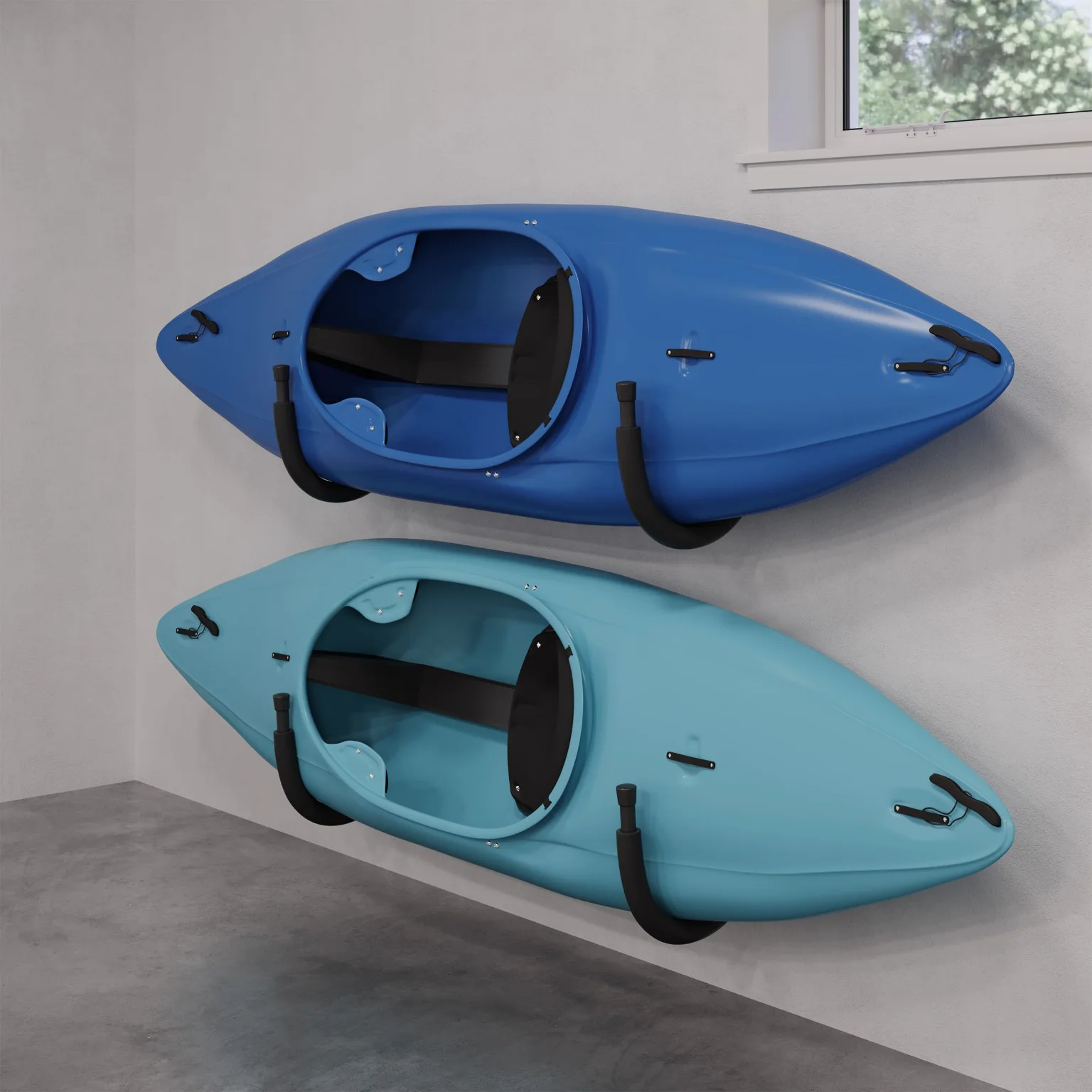
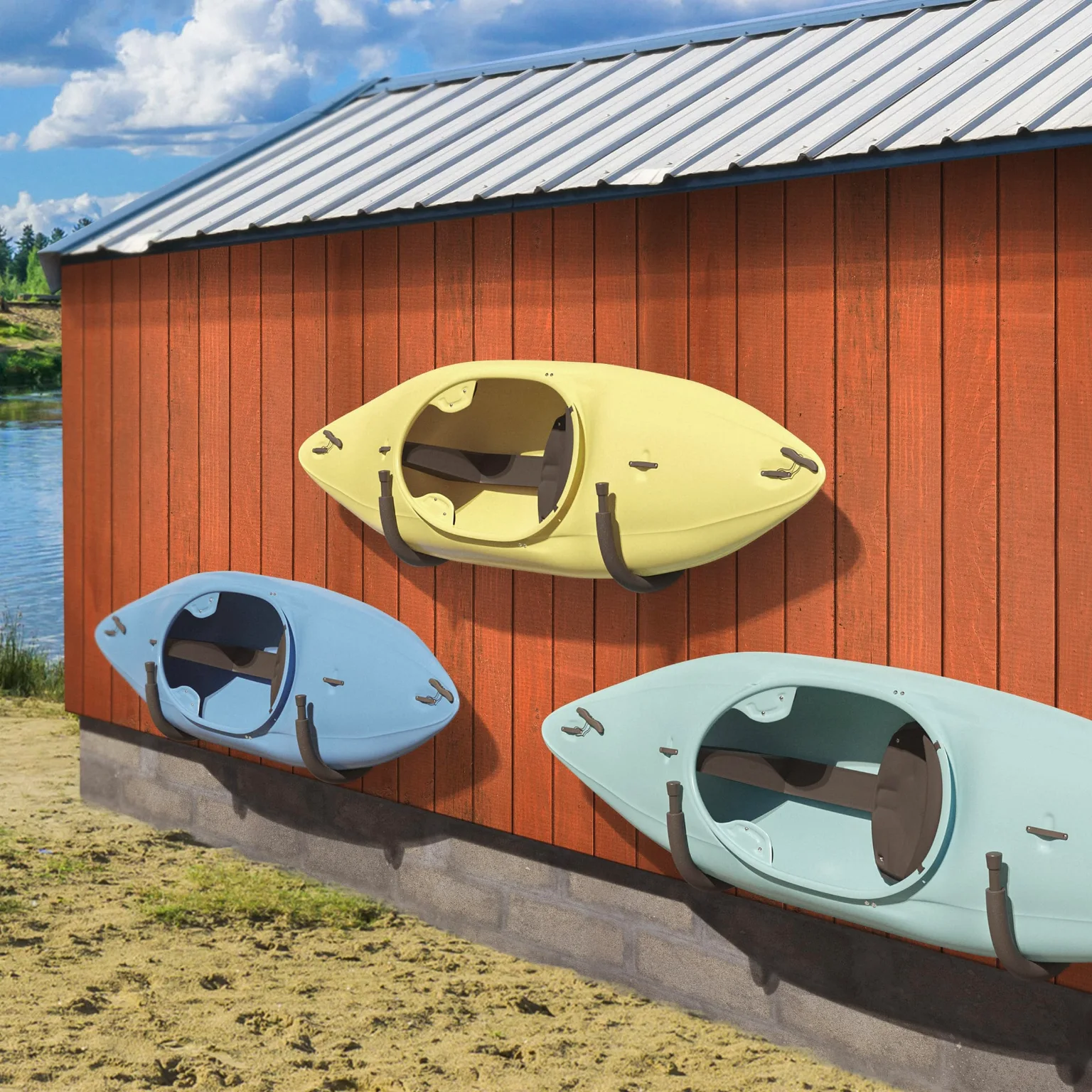
A side wall with reachable studs is often the easiest place for one or two boats. The kayak sits on edge, its strongest orientation, and it stays at chest height where you can lift it off without a ladder. Wall storage does take depth out of the garage, so measure how far a kayak lying on its side will stand out from the wall and check that the car door still opens beside it.
The RAD Sportz wall range comes in four forms. Capacity, padding and whether a strap holds the boat in are what separate them.
| Wall product | Rated capacity | What holds the boat | From the spec |
|---|---|---|---|
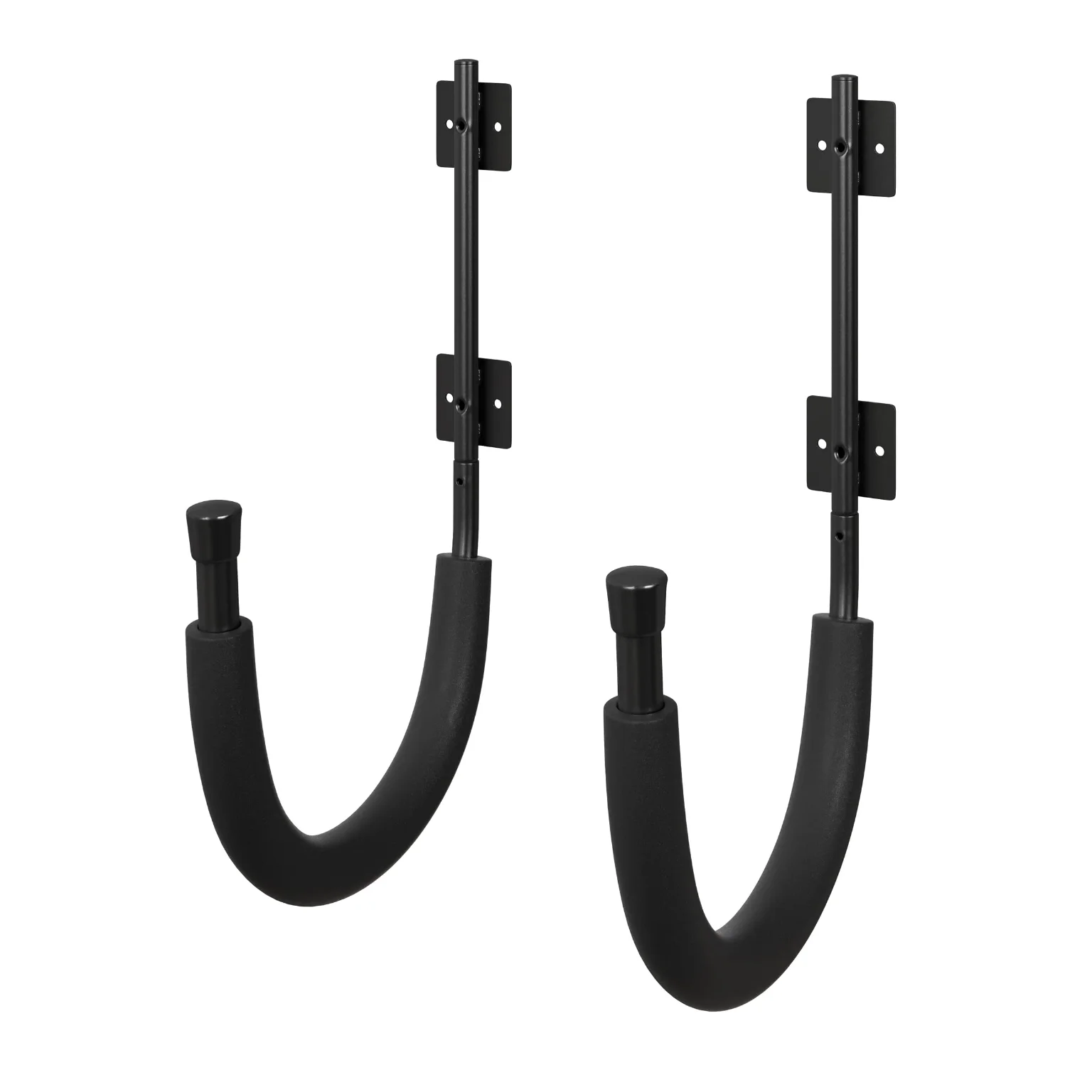
| Kayak Wall Hooks | 100 lb per pair | Foam-padded steel J-hooks | Each hook 15.25 x 3 x 25 in, sold as 1, 2 or 4 pairs |
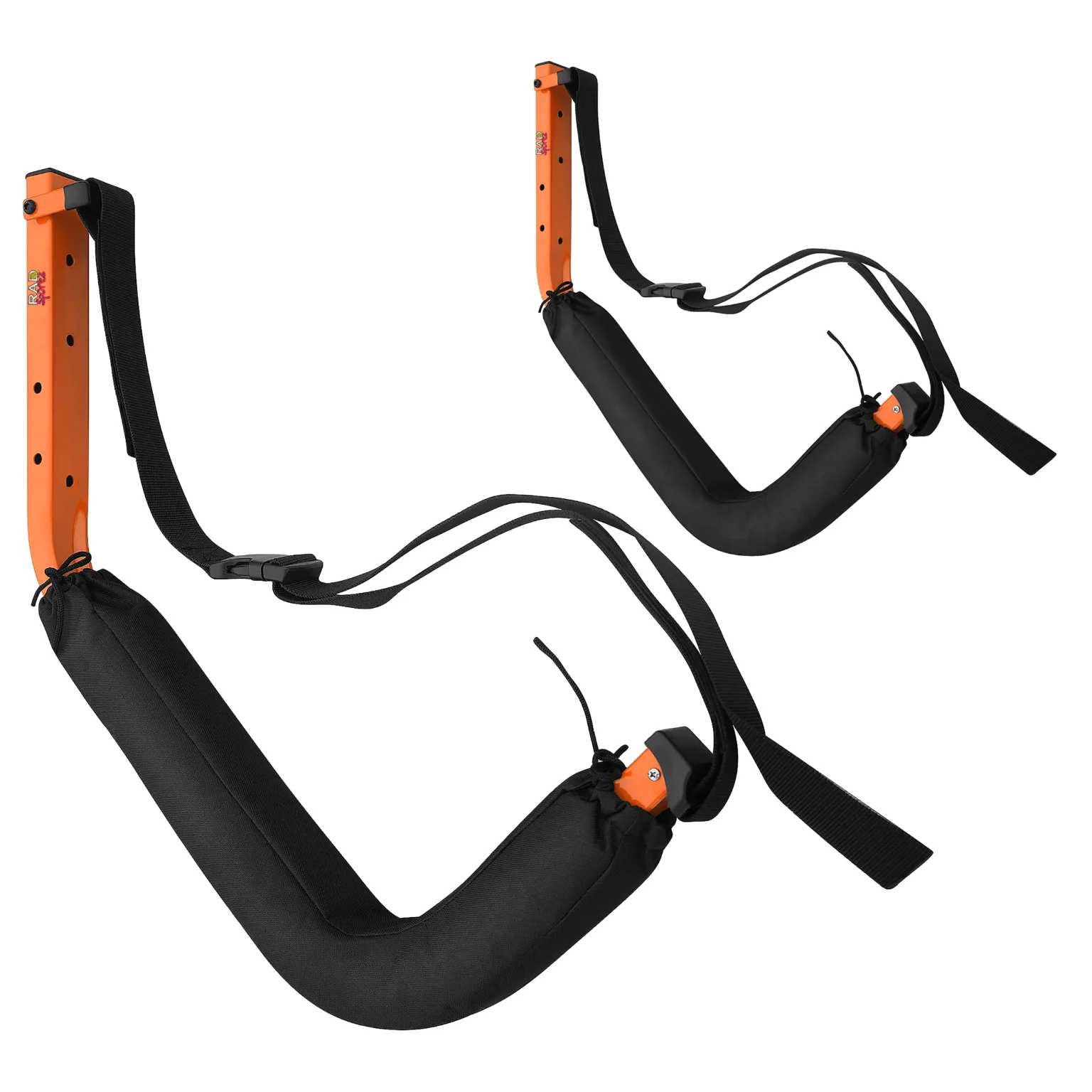
| Strapped Kayak Wall Hangers | 125 lb | Foam padding plus adjustable nylon straps and clips | Each hanger 29 in tall, reaching 13 in from the wall |
| Kayak Wall Storage System | 125 lb | Steel tubing arms with adjustable straps | One rack, or two racks with angled or padded arms |
| Wall-Mount Kayak Cradle | 110 lb | Steel tubing with lashing straps | Made for indoor or outdoor walls |
The Kayak Wall Hooks are the simplest option: two open J-hooks, padded with foam, that screw into studs. You lay the boat in on its side and lift it out again. With two or four pairs, boats can stack one above another on the same wall, provided each pair has its own studs and the boats do not rest on each other.
On the Strapped Kayak Wall Hangers, a nylon strap closes over the top of each arm. That strap earns its place on a wall where bikes, a mower or children pass by, since a bumped boat cannot roll out of a closed hanger. Each one stands 29 in tall and reaches 13 in from the wall, enough room for a wide sit-on-top lying on its side.
Steel tubing replaces the flat hook on the Kayak Wall Storage System. It comes as one rack or as a two-rack set with angled or padded arms, so a second boat or a board can share the wall. The Wall-Mount Kayak Cradle, rated for 110 lb, carries lashing straps and suits an outside wall, a dock or a boat house as well as a garage.
Space the two hooks or hangers for each boat so they meet the hull about a third of the way in from each end, and set both at exactly the same height. A boat resting on one high hook and one low hook puts most of its weight on the low one.
Freestanding racks and floor stands
Some garages cannot take a drill at all. Renting, a finished wall you want to keep intact or a block wall with no studs all point toward the floor instead. A freestanding rack carries the boats on its own frame, and a pair of low stands simply lifts a kayak off the concrete.
Freestanding Kayak Rack
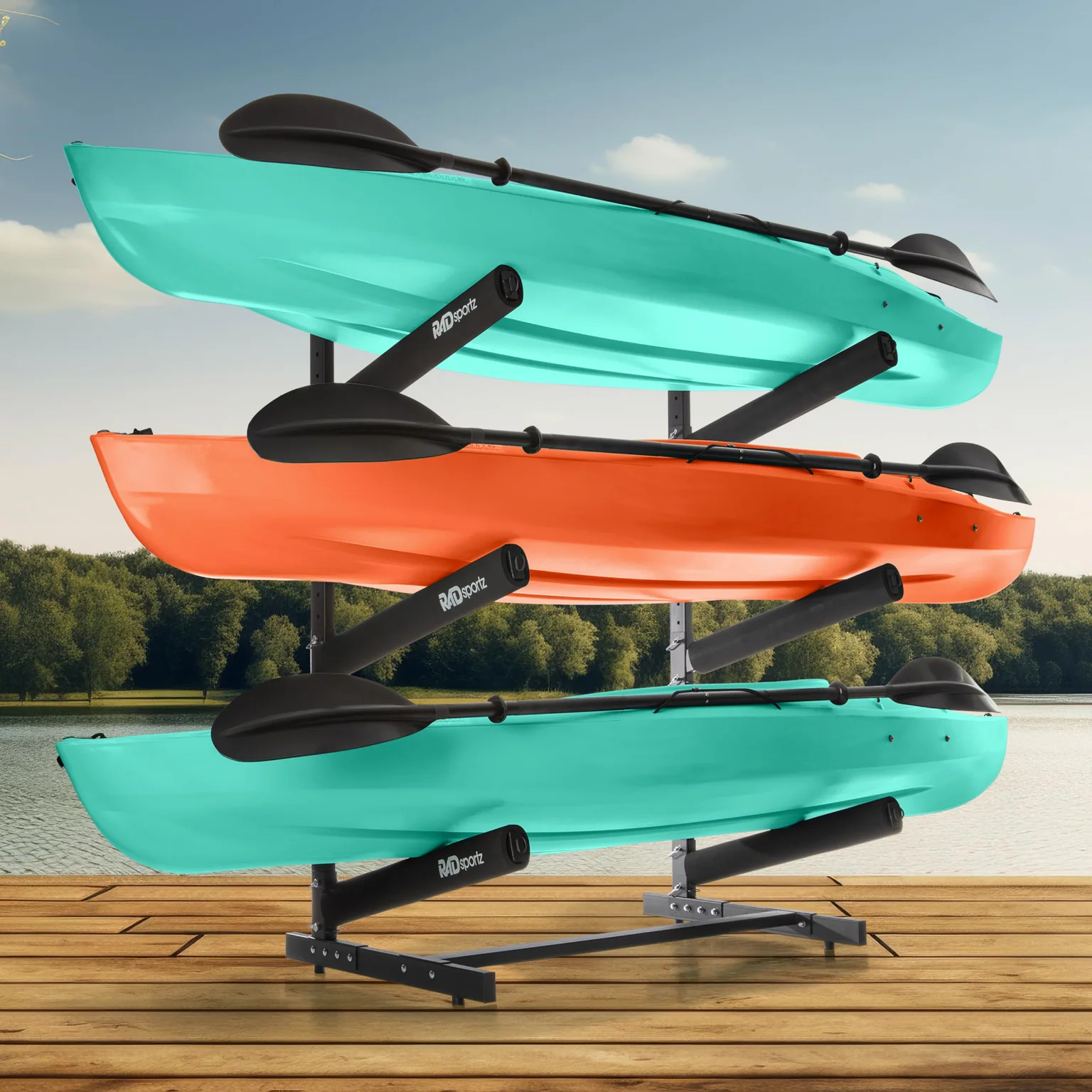
Built with 2, 3 or 4 levels, the Freestanding Kayak Rack holds boats on padded arms, one above the other. The 2-level rack is rated for 175 lb across its two boats. Its frame is powder-coated steel, its arms wear UV-protected nylon sleeves, and it stands on three feet, which settle on an uneven floor where four would rock. Hold-down anchors fix it in place, useful outdoors on a windy day and indoors wherever a car door might swing into it. It is not recommended for traditional-size canoes.
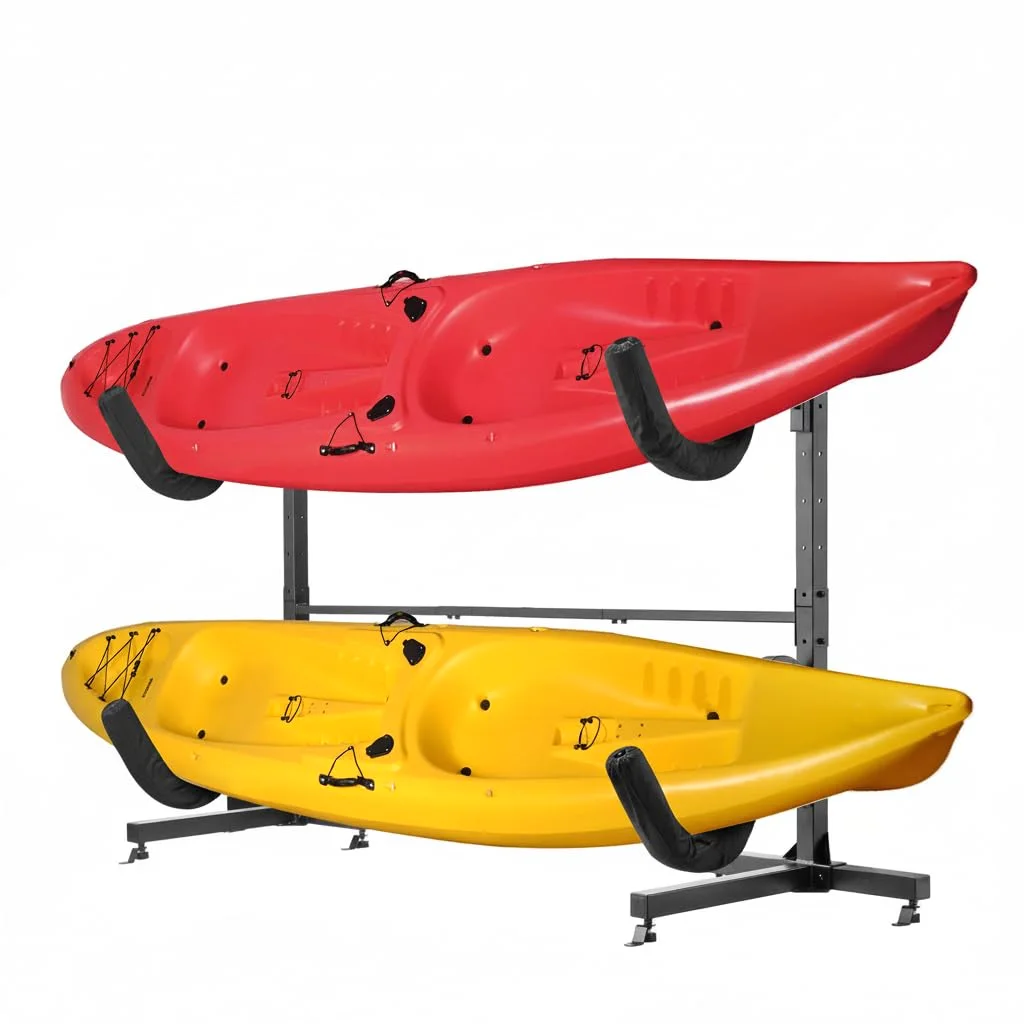
Freestanding rack
RAD Sportz Freestanding Kayak Rack
A steel tower for two, three or four boats, no drilling.
From $119.78Price range: $119.78 through $349.95
Two-Boat Kayak Stand
Two separate tripod stands make up the Two-Boat Kayak Stand. Each one is 24 by 24 in at the base and about 53 in tall, with padded J-shaped arms and nylon straps. Each set of arms holds 100 lb, for 200 lb across both boats. Because the stands are not joined, you can set them as far apart as the boat needs: closer for a short kayak, wider for a tandem. Four adjustable feet on each base cope with a sloped floor, and hold-down anchors fix the stands to a floor or a dock.
Folding Kayak Stands
Some boats only need to be off the floor for a short while: one you are cleaning or waxing, or one that waits out a brief off-season. The Folding Kayak Stands raise it 17 in off the slab on rubber bumpers, with nylon straps to steady it. The pair carries 100 lb combined, folds flat and packs into a mesh bag, so the same stands can travel to the lake. Set them about a third of the way in from each end. If the boat will stay there for months, turn it now and then so the same patch of hull does not carry the load all season.
Floor racks need floor. Measure the footprint against the path you walk between the car and the wall, and remember that the boats overhang the frame at both ends.
Boat weight against rated capacity
Each rating in the range is a number to compare with your own boat, plus whatever travels with it. Start with the hull. The weight printed in a kayak's manual usually describes the empty boat, and the one you actually lift may also carry a seat, a rudder, a fishing crate or rod holders. Weigh it yourself: stand on a bathroom scale holding the boat, note the reading, then subtract your own weight.
Next, add what the storage will carry beyond the boat. Water left in the hull after a day on the lake adds weight until it drains, so tip the boat and let it empty before it goes up. Gear clipped to the deck adds a little more, and paddles stowed in the slings of the storage straps count against the strap rating too.
Then compare the total with the product you have in mind:
- The Kayak Hoist and the Strapped Kayak Wall Hangers are rated for 125 lb.
- The Wall-Mount Kayak Cradle is rated for 110 lb.
- The Kayak Wall Hooks carry 100 lb per pair.
- The double Kayak Storage Straps carry 100 lb across two boats, and the single version carries 55 lb.
- The 2-level Freestanding Kayak Rack carries 175 lb across its boats.
- The Two-Boat Kayak Stand carries 100 lb per boat and 200 lb in total.
- The Folding Kayak Stands carry 100 lb combined.
Two boats sharing one product share its rating. On the double straps, both kayaks together must stay within 100 lb, not 100 lb each.
A rating describes the product, and the wall or ceiling behind it is a separate question. That is why every screw has to reach a stud or a joist, and why a weak or damaged ceiling needs a look before anything heavy hangs from it. A boat that comes close to a product's rating is a reason to step up a model rather than hope for the best. A heavy fishing kayak belongs on the 125 lb hangers or the hoist, not on the 100 lb hooks.
Paddleboards follow the same arithmetic. A board on wall hooks rides on its rail, the edge that works like the side of a kayak, and a board on the ceiling hangs deck down, like a kayak. Take the fin off first if it is removable, so it does not catch on the hooks or the wall.
Storing a kayak outside or under a deck
Sometimes the garage is simply full, and the boat lives on a deck, beside the house or on a dock. Sun becomes the main concern outdoors. Ultraviolet light fades color and, over seasons, weakens plastic, so shade comes first: the north side of the house, under a deck or under a deep roof overhang.
A cover handles the rest. The Kayak Cover comes in two sizes, for boats 10.8 to 12 ft long and 12.3 to 13.5 ft long, so measure your boat tip to tip before choosing. It is cut from 420D Oxford fabric with a waterproof PU coating and an anti-UV lining, and an elastic drawstring around the edge plus three adjustable buckle straps hold it on. The smaller size is 155 in long. Our guide to kayak carts, anchors and covers goes further into sizing.
Fit matters as much as fabric. In its BoatUS Magazine piece on winter storage, BoatUS says a cover should be strong, breathable and water-resistant and provide adequate ventilation, and that a well-supported cover sheds snow and ice more readily. On a kayak, that means storing the boat deck down so the cover drapes over a rounded hull instead of sagging into an open cockpit where water would pool. It also means drying the boat before covering it and leaving the cover snug rather than tight, so air can still move underneath.
Tie-down and theft
Wind moves an empty kayak easily. Both the Freestanding Kayak Rack and the Two-Boat Kayak Stand come with hold-down anchors, so use them outdoors, and close the straps over the boats. On a dock, the US Coast Guard asks owners to secure small craft on the beach, dock or vessel so they are not set adrift. Unmanned kayaks and canoes drifting loose, the bulletin notes, often cause hazards to navigation. The same bulletin urges owners to label paddle craft with an "If Found" sticker, which lets responders confirm whether someone is actually in trouble.
For theft, a cable lock through the rack and a solid point on the boat slows down an opportunist, and keeping the boat out of sight from the street helps more. Paddles, seats and PFDs come indoors. BoatUS calls indoor storage the ultimate in security and protection from the elements, which is the best argument for making room in the garage when you can.
Which setup fits your garage
Most decisions come down to one measurement: the free space you have, whether it is ceiling height, wall length or floor area. Start with whichever of those your garage has most of.
| Your space | Best fit | Why it works | Watch for |
|---|---|---|---|
| Ceiling up to 12 ft, car parked below | Kayak Hoist | Lifts 125 lb with one person on the rope brake | Door track, opener rail, clearance over the car roof |
| Low ceiling you can reach from a step stool | Kayak Storage Straps | Eyebolts into joists, two boats up to 100 lb combined | You lift the boat into the slings each time |
| Long side wall with studs, one boat | Kayak Wall Hooks or Strapped Kayak Wall Hangers | Boat on edge at chest height | Depth from the wall against the car door |
| Busy wall or two boats | Kayak Wall Storage System | Strapped arms, two-rack set | Studs for both racks at the same height |
| No drilling, rental or block wall | Freestanding Kayak Rack or Two-Boat Kayak Stand | Stands on its own frame | Footprint and overhang at both ends |
| Deck, dock or side yard | Wall-Mount Kayak Cradle or Freestanding Kayak Rack plus Kayak Cover | Outdoor-rated, hold-down anchors | Shade, ventilation, an "If Found" label |
How often you paddle changes the answer too. A boat that goes out every weekend in summer belongs where it is easiest to reach, which usually means a wall at chest height or a hoist directly above the cart. A boat that waits out the winter can go higher and further back, out of the traffic of a working garage.
Mixed fleets split well. A kayak on the hoist and a paddleboard on a pair of wall hooks below it share one corner without touching. Two kayaks on a freestanding rack leave the ceiling free for bikes, and a folding pair of stands handles the boat you are washing or repairing that week.
RAD Sportz has been around since 2008. Every piece on our Kayak & SUP Storage shelf follows the same rules: two support points, padding where metal meets the hull, and a stated rating.
Everything named in this guide is part of the RAD Sportz catalog, and our Kayak & SUP Storage shelf has every option with its price.